In our quest to help users stand out, we’ve spent a lot of time optimising algorithms and working with ML to improve the video they get from their connected cameras. We’ve also worked hard to give users greater control over that hardware, providing a better and more intuitive experience to manage their devices and make them do more. Your phone can be your webcam. Your webcam video can be a layer in a fully-realised scene. Your iPad can be a video production hub.
Even as we continued to innovate on all of these fronts, last year we began exploring ideas that reached through the user’s screen into a new frontier – their physical environment. As we knew from experience, better lighting has a profound impact on the ability of most cameras to capture good video. And as we’ve discovered while working with an ever-widening range of hardware, the HDR screens that are quickly moving from high-end laptops and monitors into the consumer space have an unprecedented range of colour and brightness. What if we found a way to put those nits to work as lumens, and use the user’s screen to effectively light them for better video?
This work started in 2024. Today, we’re excited to be launching Camo Streamlight in beta. Streamlight is a virtual ring-light app with very real power, and has these capabilities:
- Full HDR support, with special “HDR” and “Ultrabright” modes – meaning it can get really bright on machines with capable screens. No existing virtual ring light apps do HDR, and they simply don’t cut it. As you’ll see with Streamlight, the HDR experience is profoundly different when paired with an HDR-ready screen.
- Eight preset light effects that offer a range of colours, temperatures and shapes, each with a neat thumbnail so you can see what they do at a glance.
- Intuitive controls to fully customise every aspect of your light, as well as a handy global keyboard shortcut to stage-manage Streamlight’s interactions with other applications on your screen.
- Exposed functionality via Microsoft’s App Actions, making it possible to easily automate the app with creator workflows.
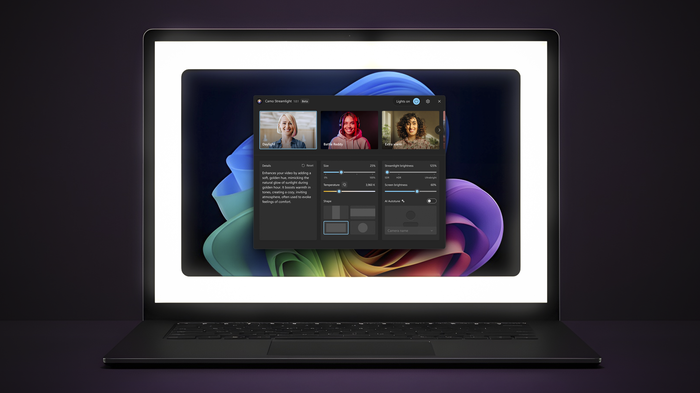
As with our other software, Streamlight is fully native and built to fit beautifully on your desktop, with the same WinUI styling as Windows 11. And after our success bringing Camo Studio to Microsoft Store, we’re launching Streamlight there too. Camo Streamlight is free, and available now for download.
Camo Streamlight is in beta, and here’s some of our roadmap:
- An effective “AI Autotune” feature that uses Windows ML to automagically get your light levels right in real-time. As you'd expect, it will take advantage of the NPU on all AI PCs, while also working great on older devices. Now available
- We’re exploring whether we bring Streamlight to other platforms. You may have read about Apple’s Edge Light – Streamlight has many similarities, although much of the work was completed long before Apple’s announcement, and Streamlight is shipping prior to Edge Light.
- We’ll expose Streamlight to MCP in future, so that it can be controlled with agents such as Copilot, or tools like Raycast.
- In the coming months, we’ll continue to optimise Streamlight's included presets
I hope you have a great experience with Streamlight. After you’ve put it through its paces in your space and with your setup, please share your feedback and show us what you’ve created with it. As ever – thanks for your support! ❤️